

Protect sensitive data and control what users, applications and AI agents can do, with security enforced at runtime directly on the device
1stProtect helps organisations prevent harmful activity on their endpoints and adopt AI with greater control. Its platform combines real-time behavioural analysis with runtime policy enforcement to interrupt malicious activity and block unauthorised actions on supported devices.
As AI accelerates cyberattacks and takes on more tasks inside the business, security needs to address both sides of the challenge: external threats and the actions of trusted users, applications and AI agents. 1stProtect brings these requirements together through a Prevention First approach, applying controls where activity happens and sensitive data is accessed.
Trusted by
Technology trusted where it matters most.
The Problem
A valid account does not make every action safe. An application can attempt to access information it does not need. A compromised process can misuse a user’s permissions. An AI agent can follow an unexpected instruction and attempt an action beyond its assigned task.
Endpoint detection and identity controls remain important. Organisations also need a way to decide whether a specific action should be allowed, and enforce that decision as the action is attempted.
Sensitive data and credentials. Files, secrets and business information can be exposed through software operating with legitimate access.
Growing agent autonomy. AI agents can use tools and execute commands, extending the impact of mistakes or malicious instructions.
Operational exposure. Unauthorised actions can lead to data loss, disruption and time spent investigating what happened.
The Solution
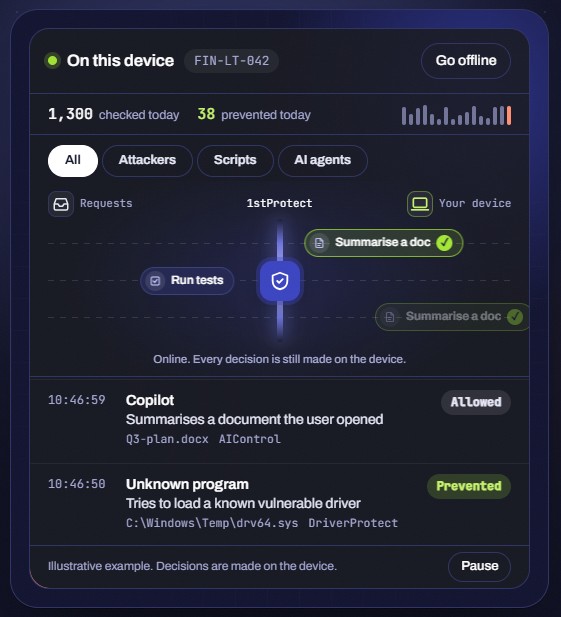
1stProtect applies defined security policies at the point of execution. On supported endpoints, it evaluates attempted activity in context and allows or blocks it according to the controls an organisation has set. This helps turn security policy into an enforceable boundary around access to data, systems and tools.
Key Capabilities and How it works
Behavioural analysis and runtime controls assess activity on the protected device, without requiring a cloud decision for every action.
Enforce the boundary.
Policies govern permitted activity, helping prevent unauthorised access, execution and data movement.
Review attempted actions.
Runtime monitoring and audit records help security teams understand activity and refine policies around business needs.
On-device enforcement enables protection to continue when a device is disconnected from the network. The platform uses a user-space architecture without kernel drivers, with an emphasis on practical deployment and a low impact on device performance.
Control AI agents with AgentProtect
AgentProtect extends runtime controls to AI agent activity, helping organisations set boundaries around credential use, file access, commands and destinations. The aim is to let agents carry out useful work within the permissions needed for their task, while restricting actions that fall outside those boundaries.
For example, a business may permit an agent to read an approved project folder while restricting access to other sensitive files, or allow an approved command while blocking an unauthorised process. The controls available depend on the supported environment and deployment configuration.
Works alongside the existing security stack
1stProtect complements endpoint detection, identity and security operations tools. Identity establishes who can sign in; runtime enforcement adds controls over what activity is permitted on the endpoint. Partners can use this approach to address specific gaps in a customer’s existing environment and demonstrate the value through a focused evaluation.
What this means for customers and partners
Set and enforce boundaries around access to sensitive data and the actions of AI agents.
Reduced exposure.
Help prevent unauthorised activity and limit the potential impact of compromised or misused permissions.
A practical adoption path.
Evaluate defined use cases on supported endpoints, alongside existing security investments, before expanding deployment.
See 1stProtect in action
Speak to Kompingo about a demonstration or proof of concept. Together, we can identify a customer use case, confirm the supported environment and agree clear success criteria for the evaluation.
